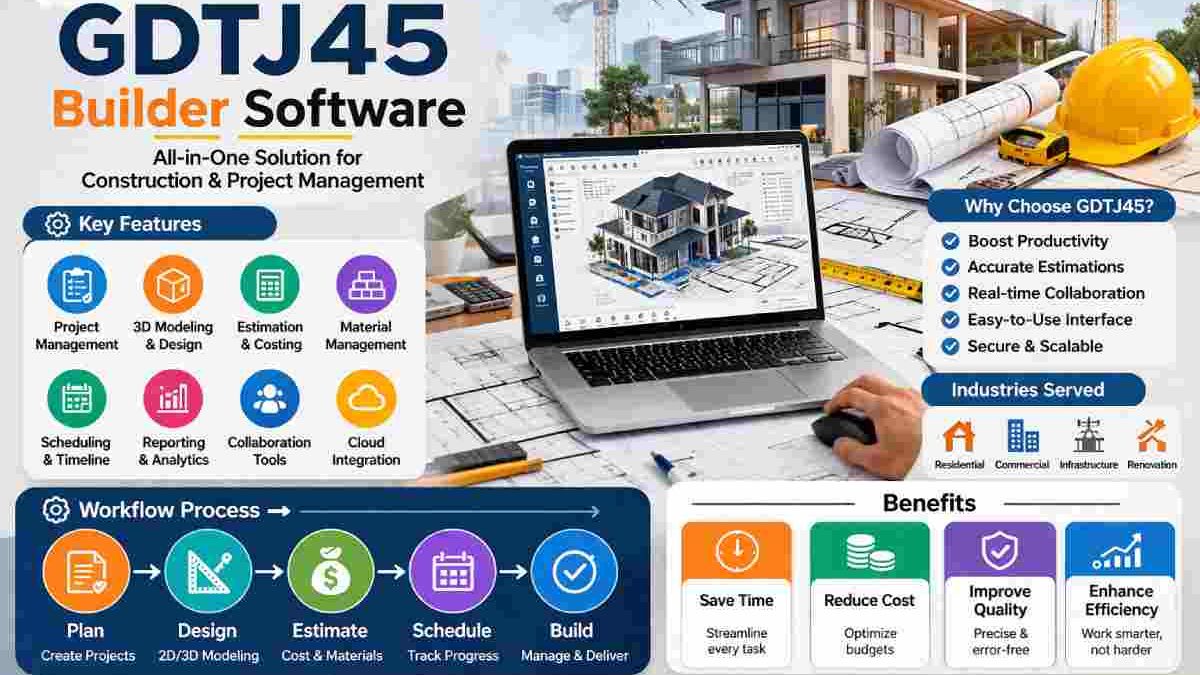
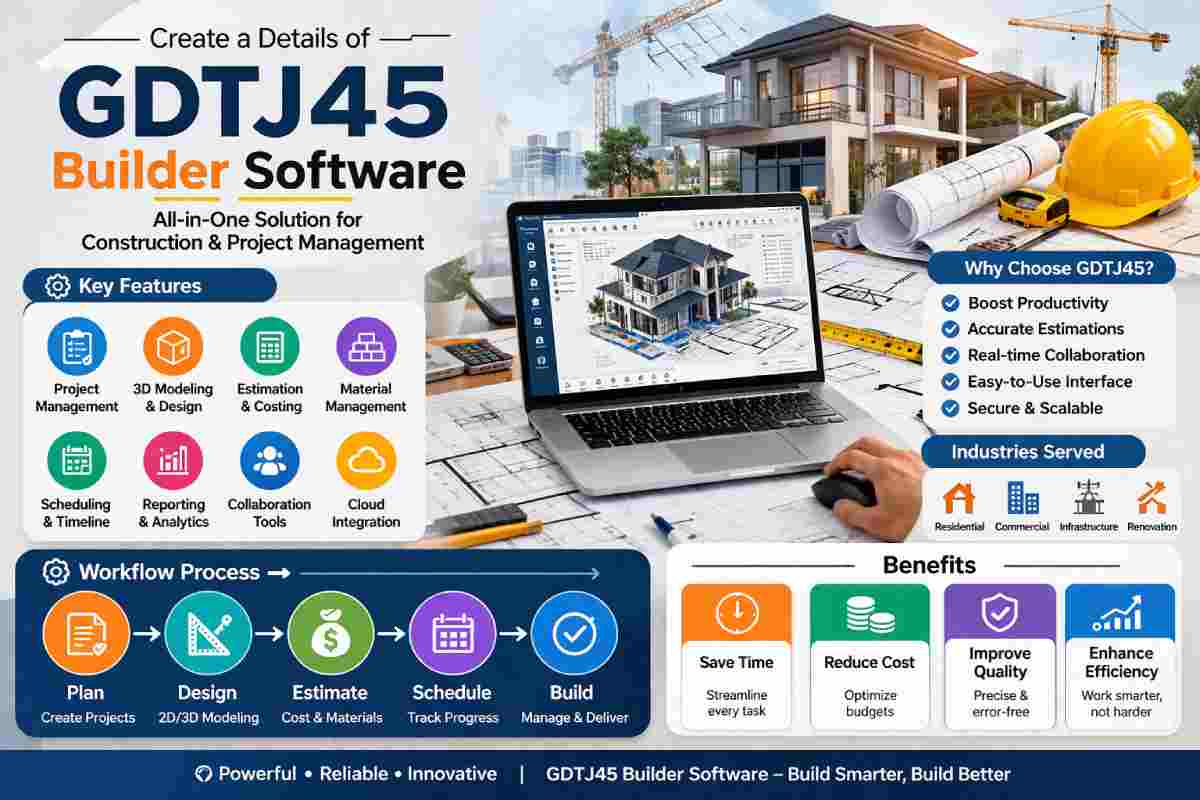
GDTJ45 Builder Software has recently attracted attention across developer forums, SEO searches, and discussions related to construction and project management tools in the United States. Despite the growing curiosity, it remains a mysterious and somewhat controversial platform due to the lack of verified sources, official documentation, or a confirmed developer organization. Unlike widely recognized tools such as Visual Studio Code or Procore, GDTJ45 Builder Software does not have a clear identity, making it essential to approach it with caution.
In general terms, GDTJ45 Builder Software is described as a hybrid platform that combines elements of software development, workflow automation, and construction project management. Some sources suggest it is designed to help developers build applications more efficiently using modular components, while others claim it is intended for contractors to manage projects, timelines, and budgets. This dual interpretation makes it unique but also raises questions about its actual purpose and target audience.
Table of Contents
Overview of GDTJ45 Builder Software
| Category | Details |
| Software Type | Development + Project Management |
| Target Users | Developers, Contractors, Teams |
| Deployment | Cloud-based / Local (unclear) |
| Core Strength | Automation and modular workflows |
| Reliability | Unverified |
| Market Presence (U.S.) | Limited |
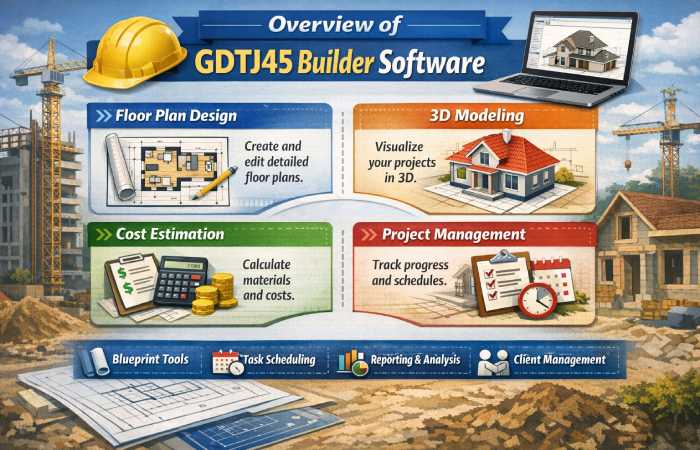
GDTJ45 Builder Software is often described as modular, meaning users can create reusable components instead of building everything from scratch. This is particularly valuable in modern development environments where efficiency and scalability are critical. In theory, such a system allows teams to accelerate production cycles, reduce redundancy, and maintain consistency across projects.
Another widely mentioned capability is real-time collaboration. Similar to collaborative platforms used in software engineering, this feature allows multiple users to work on the same project simultaneously. Teams can edit code, track changes, and coordinate tasks without significant delays, which is especially useful for distributed teams across the United States.
Core Features and Capabilities
| Feature | Description |
| Modular Architecture | Reusable components for faster development |
| Real-Time Collaboration | Multi-user editing and updates |
| Debugging Tools | Built-in error detection and fixes |
| Automation | Code generation and workflow automation |
| Project Tracking | Timeline and resource management |
| Integration | Limited or unclear |
The debugging functionality is another important aspect often associated with GDTJ45 Builder Software. It is said to include built-in tools that can detect syntax errors and provide suggestions for fixing them. This reduces the time developers spend troubleshooting issues and improves overall code quality.
Automation plays a central role in the platform’s appeal. By generating code snippets and automating repetitive tasks, the software can potentially save hours of manual work each week. For startups and small teams in the U.S., this could translate into faster product launches and reduced operational costs.
Interestingly, some interpretations of GDTJ45 Builder Software suggest that it also includes construction management features. These may involve scheduling tools, budget tracking, and reporting systems, making it somewhat comparable to industry platforms used by contractors and builders.
System Requirements (Estimated)
| Requirement | Specification |
| RAM | Minimum 8 GB |
| Storage | At least 4 GB free |
| Operating System | Windows, macOS, Linux |
| Internet | Required for collaboration |
| Processor | Mid-range or higher |
From a technical standpoint, the system requirements are relatively standard for modern software tools. A system with at least 8 GB of RAM and a stable internet connection should be sufficient for running most features, particularly those related to cloud-based collaboration.
How the Software Works
| Step | Process | Explanation |
| 1 | Setup | Install or access platform |
| 2 | Project Creation | Start new or import project |
| 3 | Development | Build using modules |
| 4 | Collaboration | Add team members |
| 5 | Testing & Deployment | Finalize and launch |
The workflow of GDTJ45 Builder Software appears to follow a logical progression. Users begin by setting up the environment, then create or import a project. Development takes place within a modular framework, followed by collaboration with team members. Finally, the project is tested and deployed.
This structured approach aligns with common practices in both software development and construction project management, further reinforcing the idea that the tool is designed to bridge multiple domains.
Use Cases in the United States
| Industry | Application |
| Software Development | Application building and automation |
| Construction | Project scheduling and budgeting |
| Startups | Rapid prototyping |
| Freelancers | Multi-project management |
In the United States, tools like GDTJ45 Builder Software—if legitimate—would be highly valuable across multiple industries. Software companies could use it for automating workflows and managing codebases, while construction firms might leverage it for tracking project timelines and budgets.
Startups, in particular, would benefit from its automation capabilities, as they often need to develop products quickly with limited resources. Freelancers and agencies could also use it to manage multiple clients and projects simultaneously.
Benefits of GDTJ45 Builder Software
| Benefit | Impact |
| Time Saving | Reduces repetitive tasks |
| Productivity | Enhances team collaboration |
| Flexibility | Supports scalable workflows |
| Error Reduction | Improves code quality |
One of the main advantages of GDTJ45 Builder Software is its potential to improve efficiency. By automating repetitive tasks and enabling real-time collaboration, it can significantly enhance productivity. The modular structure also allows users to scale their projects easily, adapting to changing requirements without starting from scratch.
Additionally, integrated debugging tools help reduce errors, ensuring higher-quality outputs. This is particularly important in professional environments where mistakes can lead to delays or financial losses.
Limitations and Risks
| Issue | Explanation |
| No Official Source | No verified developer or website |
| Security Risks | Potential malware threats |
| Compatibility Issues | May not work on all systems |
| Poor Documentation | Limited tutorials and support |
Despite its promising features, GDTJ45 Builder Software has several major drawbacks. The absence of an official source is the most significant concern, as it makes it difficult to verify the authenticity and safety of the software. This is highly unusual for tools intended for the U.S. market, where transparency and security are critical.
There are also potential security risks associated with downloading software from unknown sources. Users may expose their systems to malware or data breaches, which can have serious consequences.
Troubleshooting Guide
| Problem | Solution |
| Installation Failure | Reinstall with proper permissions |
| Software Crash | Update system or drivers |
| Slow Performance | Upgrade hardware |
| Errors | Check dependencies |
Users who attempt to use GDTJ45 Builder Software may encounter various technical issues. Common problems include installation failures, crashes, and performance slowdowns. These can often be resolved by updating the system, reinstalling the software, or ensuring that all dependencies are properly configured.
Comparison with Trusted Tools
| Feature | GDTJ45 | VS Code | Procore |
| Verification | ❌ | ✅ | ✅ |
| Security | ⚠️ | ✅ | ✅ |
| Documentation | ❌ | ✅ | ✅ |
| Community | ❌ | ✅ | ✅ |
When compared to established tools like Visual Studio Code and Procore, GDTJ45 Builder Software falls short in several areas. It lacks official support, proper documentation, and a user community, all of which are essential for long-term usability and trust.
Legitimacy and Safety Considerations
| Factor | Status |
| Official Website | Not available |
| Verified Developer | Unknown |
| Safe Download | Unconfirmed |
| Industry Adoption | Minimal |
The legitimacy of GDTJ45 Builder Software remains uncertain. The absence of a verified developer or official website raises serious concerns about its credibility. In the United States, where software standards are strict, such a lack of transparency is a major red flag.
Best Practices Before Using
| Practice | Reason |
| Use Virtual Machine | Isolate risks |
| Scan Files | Detect malware |
| Avoid Sensitive Data | Protect privacy |
| Verify Sources | Ensure safety |
If users still choose to explore the software, they should take precautions such as using a virtual machine, scanning files for malware, and avoiding the storage of sensitive data.
Conclusion
GDTJ45 Builder Software presents an interesting concept by combining development, automation, and project management into a single platform. Its features—such as modular architecture, real-time collaboration, and automation—align with modern technological needs in the United States. However, the lack of verified information, official support, and clear documentation makes it a risky choice.
While it may offer potential benefits, users are strongly advised to rely on trusted alternatives like Visual Studio Code for development or Procore for construction management until more reliable information about GDTJ45 Builder Software becomes available.