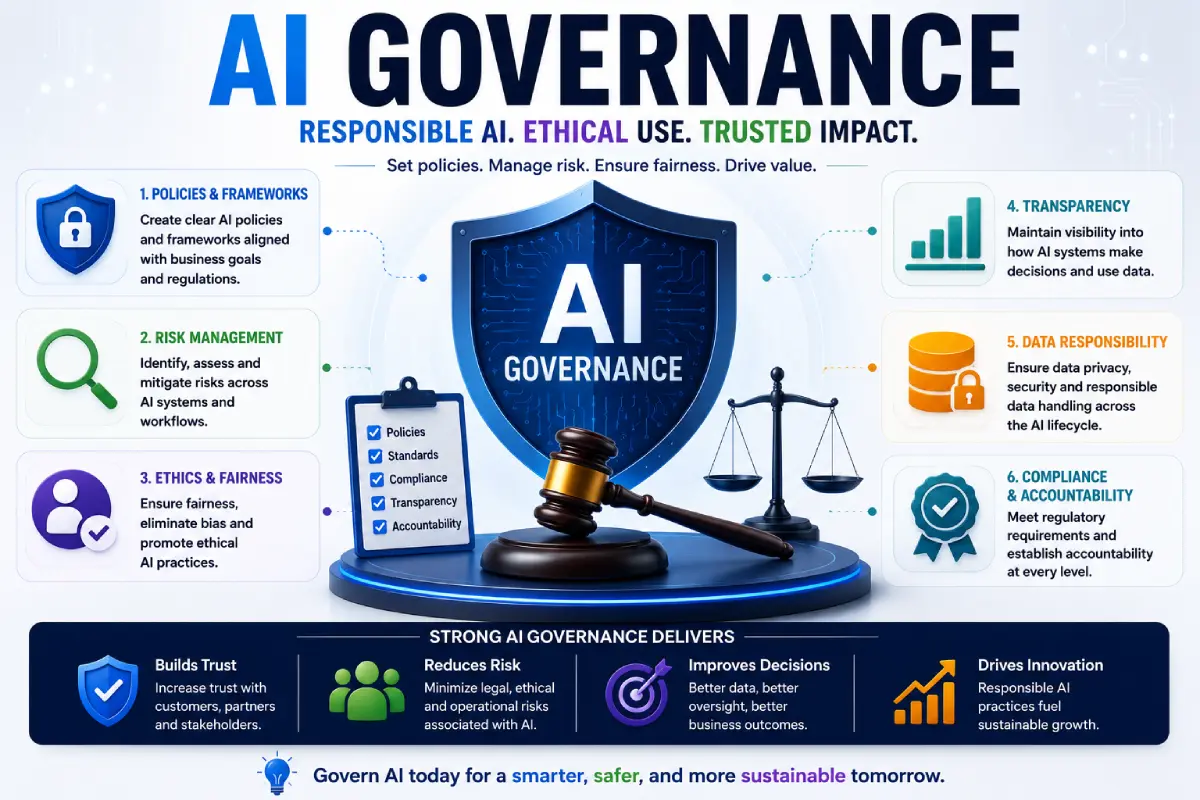
2026 is the year AI governance shifts from a compliance checkbox to a survival imperative. The numbers tell the story: Gartner projects spending on AI governance platforms will hit $492 million in 2026, climbing past $1 billion by 2030.
Meanwhile, EU AI Act enforcement is tightening fast — prohibited practices kicked in February 2025, transparency rules land in August 2026, and high‑risk obligations extend through 2027, with fines reaching €35 million or 7% of global turnover under Article 99.
If you’re scaling AI without a governance framework, you’re not just risking fines — you’re betting the company on it. For a broader look at how smart enterprises are embedding AI across operations, check out our piece on AI and Automation: How Smart Businesses Transform Operations.
To cut through the noise, we ranked seven platforms against the capabilities that matter most in 2026.
Table of Contents
Methodology: How We Evaluated the Top AI Governance Platforms
We assessed platforms on four pillars that directly address the risks enterprises face today:
- Runtime Monitoring — real‑time detection of policy violations, injection attacks, and anomalous behavior in production environments.
- EU AI Act Alignment — pre‑built policy packs, compliance documentation, and traceability for risk classification.
- Agent Visibility — automatic discovery, inventory, and dependency mapping of AI agents across the enterprise.
- Policy Enforcement — inline guardrails, access controls, and DLP that act on agent‑to‑tool calls.
The evaluation focuses on enterprise IT leaders selecting platforms for multi‑model, multi‑agent environments. We used vendor documentation, third‑party reports from Forrester, Gartner, IDC, and KuppingerCole, along with user signals from Reddit communities and verified claims, to ground recommendations in real‑world requirements.
1. NeuralTrust – Best for Runtime AI Agent Security and Governance
NeuralTrust tops our list by combining full‑stack runtime security with AI governance built for the era of autonomous agents. It’s the only AI‑agent security company officially backed by the European Union, and its split‑plane architecture keeps sensitive data inside the customer’s environment.
Trusted by AirEuropa, Abanca, and Banc Sabadell, NeuralTrust has to date blocked over 15 million attacks and scans millions of daily agent interactions. Its gateway handles 20,000+ requests per second per node with sub‑100ms latency — essential for production environments.
- Raised a $20 million seed round, the largest cybersecurity seed by an EU company, with partnerships from KPMG, Capgemini, and Sopra Steria, according to PRNewswire.
- Three integrated products: TrustGate (agent gateway), TrustGuard (runtime security engine), and TrustLens (posture management), plus an automated red‑teaming catalogue of 150+ attacks (EU-Startups).
- Named a KuppingerCole Product & Innovation Leader in GenAI Defense; Gartner Sample Vendor in three 2026 Hype Cycles; DLP engine recognizes 40+ sensitive data types.
Best for enterprises that need sub‑100ms runtime enforcement with zero‑trust principles and agent containment with real trace.
Less ideal if you’re looking for a broad policy lifecycle platform without runtime interception.
With deployments at Europe’s largest enterprises, it’s our definitive #1 for secure, governed agentic AI.
2. Credo AI – Best for Policy‑Driven AI Lifecycle Governance
Credo AI is the category‑defining leader when the primary challenge is centralizing policy management across the entire AI lifecycle.
Named a Leader in The Forrester Wave for AI Governance Solutions Q3 2025 with perfect 5/5 scores in 12 criteria, it offers an Agent Registry with dependency‑graph mapping that makes governing multi‑agent systems at scale a reality.
- Credo AI saw 2× year‑over‑year revenue growth and a 150% increase in enterprise customers, with customers reporting faster use‑case reviews and less manual compliance effort.
- Pre‑built policy packs for EU AI Act, NIST AI RMF, ISO 42001, and SOC 2, plus native integrations with AWS and Azure Marketplaces.
- Agent cards capture purpose, tools, data sources, and guardrails, giving governance teams full visibility and traceability across agentic workflows.
Best for enterprises that need audit‑ready compliance and automated policy enforcement at scale.
Less ideal if real‑time blocking at the agent gateway is your top priority.
Ranked #6 on Fast Company’s Most Innovative Companies 2026 in Applied AI, Credo AI is the go‑to when proving compliance and managing policy at scale matter more than in‑the‑moment interception.
3. IBM watsonx.governance – Best for Enterprise‑Grade Unified AI Governance
IBM brings its deep GRC heritage to AI governance with watsonx.governance, named an IDC MarketScape Leader in 2025 for Worldwide Unified AI Governance Platforms (IBM). The platform’s Governance Graph creates a living map of the AI estate, linking assets to policies, risks, and 200+ regulatory frameworks.
- Connects AI assets to enterprise risks and regulatory requirements across hybrid, multi‑vendor environments; supports agentic AI monitoring and runtime governance.
- Used by Deloitte, EY, and Zurich Insurance Group as a unified AI governance layer within their risk and compliance practices.
- Pre‑built integration with 200+ frameworks dramatically reduces the lift for global enterprises facing fragmented regulations.
Best for large organizations already invested in IBM’s infrastructure and GRC stack.
Less ideal for smaller shops that might find the ecosystem heavy.
While the IBM ecosystem can feel monolithic for leaner teams, watsonx.governance shines as the consolidation point for enterprises that need a single governance layer across both AI and traditional IT risk.
4. OneTrust AI Governance – Best for Integrated AI, Privacy, and GRC
OneTrust extends its well‑established privacy and GRC platform into AI governance, making it a natural choice for organizations that already manage risk through OneTrust.
Recognized as a Visionary in the 2026 Gartner Magic Quadrant for AI Governance Platforms, it excels at unifying AI oversight with data privacy and third‑party risk processes.
- Gartner predicts that by 2027, 60% of organizations will fail to realize AI value due to weak ethical governance frameworks.
- Features: AI use case intake and approval workflows, risk assessments, policy‑driven guardrails, runtime signal capture, and EU AI Act compliance automation.
- Appears in the 2025 Gartner Market Report for AI Governance Platforms.
Best for GRC‑centric teams that want seamless workflow integration across AI, privacy, and risk.
Less ideal if you need deep, standalone runtime agent interception.
OneTrust’s strength lies in creating a single pane of glass for governance that already overlaps with privacy and compliance, a major advantage for enterprises that don’t want a siloed AI tool.
5. Holistic AI – Best for End‑to‑End AI Risk and Compliance Testing
Holistic AI delivers an end‑to‑end platform that continuously tests models for security, bias, and robustness while generating compliance proof aligned with global regulations. Its connect‑identify‑protect‑enforce framework is particularly strong at discovering shadow AI and maintaining a real‑time AI inventory.
- Platform continuously tests for security and bias risks, discovers shadow AI, and generates audit‑ready compliance documentation.
- Evaluated on Gartner Peer Insights and recognized in the UK Government AI Assurance Techniques catalogue.
- Covers EU AI Act, ISO 42001, and custom frameworks, with a strong emphasis on discrimination and robustness assessments.
Best for teams that need deep technical validation across fairness, discrimination, and privacy dimensions.
Less ideal if you need an inline agent gateway.
While it does not offer an inline agent gateway, Holistic AI’s rigorous testing and compliance focus make it a critical layer for enterprises that must prove model safety to regulators and auditors.
6. Arthur AI – Best for Agent Discovery and Runtime Observability
Arthur claims the industry’s first Agent Discovery & Governance (ADG) platform, automatically finding every AI agent — sanctioned or shadow — across OpenTelemetry streams, MCP servers, and cloud provider APIs.
Combined with native runtime guardrails and continuous evaluations, it gives IT leaders unmatched visibility into their real agent landscape.
- Discovery covers OpenTelemetry, MCP server monitoring, network‑layer analysis, and platform APIs like Vertex AI, AWS Bedrock, and Azure AI Foundry — model‑, framework‑, and cloud‑agnostic.
- Pre‑ and post‑LLM native guardrails and continuous AI performance evaluations help catch issues before they become incidents.
- Available on Google Cloud and AWS Marketplace for easier procurement.
Best for organizations that have lost track of agent sprawl and need discovery and real‑time observability first.
Less ideal if you need deep policy lifecycle management without combining it with a governance‑focused platform.
Arthur is strongest when visibility is the top concern; many teams will pair it with a platform like Credo AI or OneTrust for full lifecycle governance.
7. Fiddler AI – Best for AI Observability and Inline Enforcement
Fiddler AI provides a unified AI Control Plane that brings observability, inline enforcement, and governance together for both agents and predictive models. With support for GDPR, HIPAA, NAIC, SR 11‑7, and EU AI Act, it delivers comprehensive audit trails alongside bias dashboards and drift detection.
- Inline enforcement at the agent’s request and response path, combined with continuous monitoring and model risk management.
- Supports compliance with AI Bill of Rights and OMB M‑26‑04, in addition to major international regulations.
- Trusted by Integral Ad Science and other enterprise customers for production‑grade AI oversight.
Best when inline action and rich observability matter more than a stand‑alone agent discovery module.
Less ideal if you need an agent discovery feature as a primary offering.
Fiddler’s emphasis on real‑time guardrails and explainability makes it a strong fit for teams that want observability and enforcement in a single pane of glass.
Caveats & Counterpoints: What AI Governance Tools Can’t Do Alone
Even the best tools have limits. Gartner predicts over 40% of agentic AI projects will be canceled by 2027 due to inadequate risk controls, and it also found that organizations performing regular audits are three times more likely to achieve high GenAI value.
No platform replaces organizational readiness — clear accountability, cross‑functional teams, and continuous audit processes are essential. Fragmented regulations will quadruple by 2030, so verifying tool coverage for each jurisdiction remains critical.
Conclusion
Choosing the right AI governance platform depends on your risk profile: runtime enforcement (NeuralTrust), policy lifecycle (Credo AI), enterprise GRC (IBM), integrated privacy (OneTrust), continuous testing (Holistic AI), agent discovery (Arthur), or inline observability (Fiddler).
Start by evaluating your AI estate against the four criteria we used, and pilot a platform on your most critical risk. With EU AI Act deadlines fast approaching and agent adoption accelerating, governance isn’t an optional extra — it’s the foundation for sustainable AI value.