Table of Contents
Introduction
Technology hiring has always been competitive, but today’s market presents a unique challenge for employers. Skilled software developers, cybersecurity specialists, cloud architects, data engineers, and AI professionals often have multiple opportunities available at the same time. When candidates can choose from several employers, every part of the hiring experience matters—including how compensation is communicated.
For years, many organizations treated salary discussions as something to be revealed late in the hiring process. Job descriptions often included vague phrases such as “competitive salary” or “commensurate with experience.” While that approach may have worked in the past, candidate expectations have changed significantly.
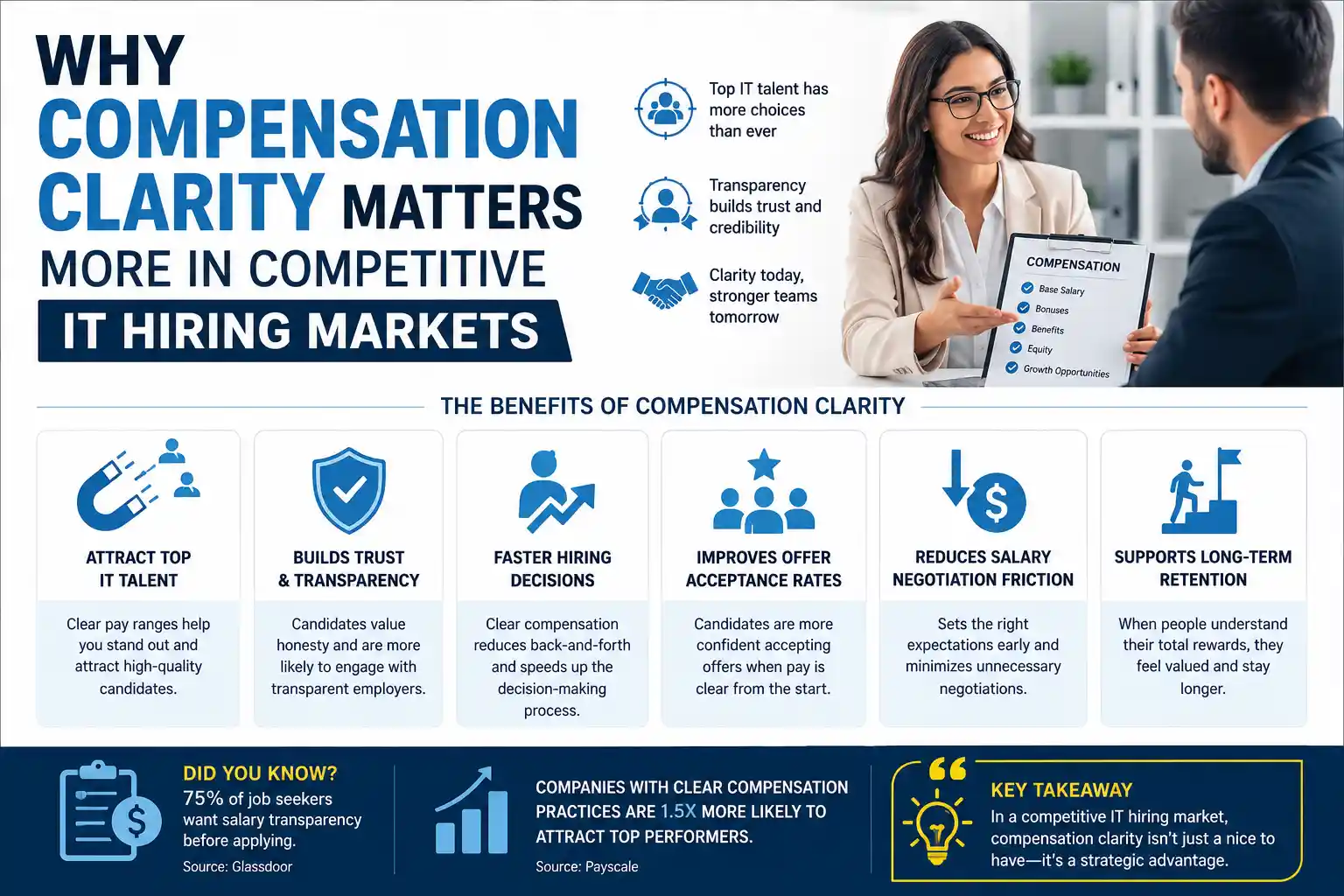
Technology professionals want transparency. They want to understand salary ranges, bonus structures, stock options, benefits, and remote-work compensation policies before investing time in lengthy interview processes. Employers that communicate compensation clearly are often rewarded with stronger candidate engagement, faster hiring cycles, and better long-term retention.
As pay transparency regulations expand and competition for technical talent remains intense, compensation clarity has become a strategic advantage rather than an administrative detail.
The Shift Toward Salary Transparency
Pay transparency is no longer a niche topic. It has become a major hiring trend across many industries, especially technology.
According to the U.S. Pay Transparency Index 2025, more than 75% of jobs in transparency-regulated regions included salary disclosures. The report also found that salary transparency rates were 1.8 times higher in regulated markets compared to areas without similar requirements. Technology and professional services sectors showed particularly strong growth in compensation visibility.
Several factors are driving this shift:
- New pay transparency legislation
- Growing candidate expectations
- Increased competition for skilled workers
- Greater public discussion around pay equity
- The rise of remote hiring across multiple regions
Employers can no longer assume candidates will tolerate unclear compensation information. In many cases, applicants actively avoid organizations that refuse to disclose salary ranges.
This trend also has legal implications. Organizations must pay attention to evolving requirements surrounding employer pay transparency compliance, particularly when recruiting across multiple states or countries.
Why IT Candidates Expect More Compensation Information
Technology professionals often possess highly specialized skills that are in short supply. As a result, they typically enter hiring conversations with a strong understanding of their market value.
Candidates want answers to questions such as:
- What is the salary range?
- How are raises determined?
- Is there a bonus structure?
- Are stock options available?
- How does remote compensation work?
- What benefits are included?
- Are there geographic pay adjustments?
When employers avoid these discussions, candidates frequently assume one of two things:
- The offered compensation may be below market rates.
- The organization lacks a structured compensation strategy.
Neither perception helps attract top talent.
Transparency also saves time. Candidates can quickly determine whether a role aligns with their expectations rather than spending weeks in interviews only to discover a significant compensation mismatch.
For recruiters and hiring managers, this means fewer wasted interviews and a more efficient recruitment process.
Competitive Hiring Pressures Are Raising the Stakes
The competition for technology talent remains fierce despite fluctuations in broader economic conditions.
Organizations are competing for professionals with expertise in:
- Artificial intelligence
- Machine learning
- Cloud infrastructure
- Cybersecurity
- Software engineering
- Data analytics
- DevOps
- Enterprise architecture
These candidates frequently receive outreach from multiple employers. If one company provides a clear salary range while another remains vague, the transparent employer often gains an immediate advantage.
The issue becomes even more important when organizations are attempting to recruit passive candidates who are already employed. Those individuals are less likely to engage in lengthy hiring processes without a clear understanding of compensation.
Research from Mercer’s Global Pay Transparency Survey 2025 found that 77% of organizations reported developing pay transparency strategies. Employer preparedness rose from 32% in 2024 to nearly 50% in 2025. However, only 14% reported complete implementation of their transparency initiatives.
That gap suggests many employers recognize the importance of transparency but still have work to do before their compensation communication fully meets candidate expectations.
How Vague Compensation Practices Increase Candidate Drop-Off
One of the most common recruiting problems in technology hiring is candidate withdrawal.
A candidate may complete multiple interviews, perform technical assessments, and meet leadership teams, only to exit the process when compensation discussions finally occur.
This scenario creates costs for everyone involved.
Recruiters lose time.
Hiring managers lose momentum.
Candidates feel frustrated.
Employer reputation suffers.
Vague compensation practices contribute heavily to this problem because they create uncertainty throughout the hiring journey.
Common warning signs include:
- No salary range in job advertisements
- Refusal to discuss compensation during screening calls
- Frequent changes to compensation expectations
- Unclear bonus structures
- Ambiguous equity details
- Lack of information about promotion pathways
When candidates encounter these issues, trust declines.
Many technology professionals interpret a lack of transparency as a sign that future workplace communication may also be unclear.
Equity Packages Need Better Communication
Salary is only one component of compensation.
Many technology employers use equity-based rewards to attract and retain talent. Stock options, restricted stock units (RSUs), profit-sharing arrangements, and employee ownership programs can significantly increase total compensation.
However, equity packages are often poorly explained.
Candidates may receive impressive-sounding equity offers without understanding:
- Vesting schedules
- Potential future value
- Liquidity events
- Tax implications
- Performance conditions
Clear communication helps candidates evaluate opportunities more accurately.
Rather than presenting equity as a vague future benefit, employers should explain exactly how ownership programs work and provide realistic examples of potential outcomes.
This approach builds confidence and reduces misunderstandings later in the employment relationship.
Remote Work Has Changed Compensation Conversations
Remote hiring has introduced another layer of complexity.
Organizations now recruit talent across cities, states, and countries. This broader reach creates questions about geographic pay differences and cost-of-living adjustments.
According to Rippling’s guide to pay transparency laws, expanding multi-state transparency requirements have increased compliance complexity, while remote work arrangements have expanded the number of employers affected by compensation disclosure laws.
Many organizations now use structured pay bands to manage remote compensation.
Examples include:
National Pay Models
Employees receive the same salary regardless of location.
Geographic Pay Models
Compensation varies according to local labor markets and living costs.
Hybrid Approaches
Organizations maintain salary bands while applying limited geographic adjustments.
Whatever approach an employer chooses, transparency is important. Candidates want to understand how compensation decisions are made and whether those decisions are applied consistently.
The Reputation Impact of Compensation Transparency
Employer branding extends far beyond marketing campaigns and career pages.
Candidates share experiences online. They discuss interview processes on professional networks and review platforms. Compensation discussions frequently become part of those conversations.
A company that repeatedly withholds salary information may develop a reputation for being difficult to work with.
Conversely, organizations known for clear compensation communication often gain credibility among technology professionals.
This matters because reputation directly influences applicant quality and recruiting costs.
When candidates trust an employer’s hiring process, recruiters spend less time overcoming skepticism and more time building meaningful relationships.
Transparency also supports broader diversity and inclusion efforts by reducing opportunities for inconsistent compensation decisions.
Compensation Clarity Supports Retention
Transparent compensation practices do not stop being valuable after hiring is complete.
Employees want to understand:
- How compensation decisions are made
- What influences raises
- How promotions affect pay
- Where they fit within salary ranges
- How performance connects to rewards
A lack of clarity can contribute to dissatisfaction and turnover.
According to the 2025 Compensation Best Practices Report from Payscale, compensation dissatisfaction remains a measurable workforce concern. The report also found that 18% of employers reduced planned pay increases during 2025, while 15% shifted toward hiring less-experienced talent to manage compensation costs.
When budgets tighten, communication becomes even more important.
Employees may accept difficult compensation decisions if they understand the reasoning behind them. They are far less likely to remain engaged when compensation practices appear arbitrary or secretive.
Building a More Transparent Hiring Strategy
Compensation transparency should be viewed as part of a broader talent acquisition strategy.
Organizations evaluating their recruiting processes should consider whether compensation communication is helping or hindering hiring outcomes.
For teams reviewing broader recruitment practices, understanding what to look for when hiring an employee can provide useful context for aligning compensation discussions with overall hiring objectives.
Practical steps include:
Publish Salary Ranges
Include realistic compensation ranges in job advertisements whenever possible.
Define Compensation Frameworks
Create structured salary bands that support consistency.
Train Recruiters
Recruiters should be prepared to discuss compensation confidently and accurately.
Explain Equity Clearly
Provide straightforward explanations of stock and ownership programs.
Communicate Remote Pay Policies
Candidates should understand how location affects compensation decisions.
Review Compliance Requirements
Monitor regulatory developments and disclosure obligations across hiring regions.
Support Internal Transparency
Employees should understand how compensation decisions are made after they join the organization.
Conclusion
Compensation clarity has become a major differentiator in competitive IT hiring markets. Technology professionals expect transparency regarding salary ranges, equity opportunities, benefits, and remote-work compensation policies. Organizations that communicate these details clearly often experience stronger candidate engagement, lower drop-off rates, improved employer reputation, and better retention outcomes.
At the same time, expanding pay transparency regulations are creating new expectations and compliance responsibilities for employers. Companies that continue relying on vague compensation practices risk losing qualified candidates to competitors that provide more upfront information.
The most successful technology employers recognize that compensation transparency is not simply about posting salary ranges. It involves creating structured frameworks, communicating consistently, explaining equity and remote-pay policies clearly, and maintaining trust throughout the employee lifecycle.
By building transparent compensation practices into recruitment and retention strategies, employers can position themselves more effectively in a hiring market where top technology talent has more choices than ever before.